
Unhiding the hidden side of organizational knowledge
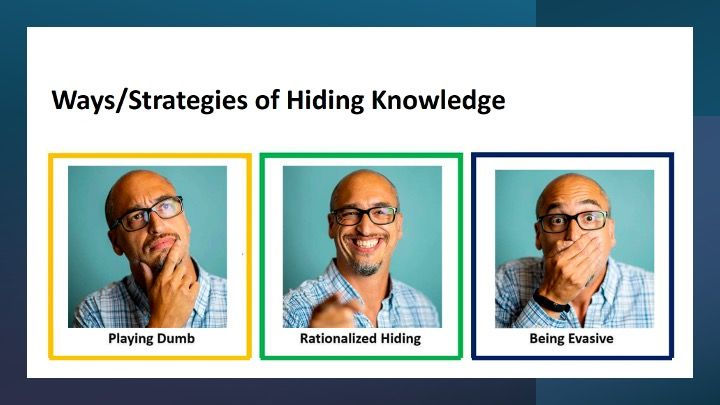
This week in the Knowledge Management Global Network (KMGN) course "From Strategy to Business Impact", Kaiyu Yang (Karrie) and Vincent Ribiere led a fascinating session on Knowledge Sharing vs. Knowledge Hiding.
One particularly important insight:
knowledge sharing and knowledge hiding are not opposite ends of the same scale.
An employee may actively share knowledge in some situations while intentionally hiding it in others. The drivers are different: sharing is often influenced by trust, reciprocity, and collaboration 🤝, while hiding is linked to fear, insecurity, power, perceived cost, or lack of trust 🔒. Increasing sharing does not automatically reduce hiding.
A second insight I found especially interesting was the distinction between different forms of knowledge hiding:
> playing dumb 🙀
> rationalized hiding 💬
> evasive hiding 🫥
Some are obvious. Others are subtle, socially acceptable, and much harder to detect inside organizations.
And perhaps the most thought-provoking message of all:
> Not all knowledge hiding is necessarily negative.
Sometimes people hide knowledge to preserve confidentiality, protect others, or encourage self-development ⚖️. The real challenge is therefore not simply “maximizing sharing,” but understanding the context, intention, and organizational impact behind behaviors.
The session reinforced a powerful reminder:
Knowledge flows at the speed of trust 🤜 🤛
And once trust flickers, even the best KM systems struggle to compensate ✨