
Deeper, Wider, Wiser - Book Review

Deeper, Wider, Wiser explores symbiotic intelligence: a partnership combining AI’s speed and analytical power with human judgment, meaning, and ethical responsibility. Authors Alex Bennet, Robert Turner, and Cheng Gong outline seven human capacities and practical exercises to strengthen independent thinking, navigate complexity, and make wiser decisions when working with AI.
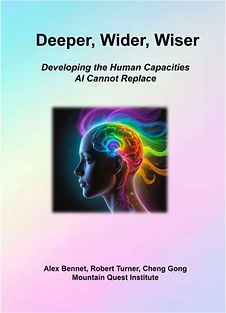
Alex Bennet, Robert Turner, and Cheng Gong wrote Deeper, Wider, Wiser: Developing the Human Capacities AI Cannot Replace, published in 2026.
The book addresses an important question raised by the development of artificial intelligence: what capacities must we, as human beings, develop so AI does not replace our thinking but instead lets us reach new capacities together? The authors' starting point is that as AI capabilities develop, the need to develop human capacities does not shrink — it actually grows. Without this development, the great advantages of AI may gradually weaken precisely the human capacities that partnership with it requires.
The authors call the advanced combination of the two intelligences Symbiotic Intelligence — a partnership in which AI brings capabilities of scale, speed, pattern recognition, and the ability to handle many dimensions at once. In contrast, the human brings depth, meaning, judgment, context, values, and wisdom. The goal is not to choose between human and machine, but to reach together what neither can achieve alone.
The book's ideas rest on the Whole Thought framework developed by Bennet and Turner, and on the world of Knowledge Capacities derived from it. For more, see the book review Whole Thought: The Rise of Human Intelligence on the ROM website. This review focuses on the seven capacities the authors identify as especially critical for the age of symbiotic intelligence.
Main topics covered in this review:
These seven capacities are not merely a list of desirable skills. They form a developmental sequence: each capacity adds a layer to those before it, and the last, Complexity Navigation, rests on the six that precede it.
In my view, this is a must-read. Not only to learn how to use AI better, but above all to think about how we ourselves need to keep developing in the new era. The book offers an optimistic yet demanding outlook: symbiotic intelligence is not created merely by AI improving — we need to improve too.
Pattern Perception
Essence
The ability to apply human judgment in identifying, analyzing, applying, and developing patterns, to interpret their meaning in context, and to guide their use wisely.
Explanation
Pattern recognition is one of AI's clearest strengths. It can quickly identify connections, correlations, anomalies, and patterns in volumes and scopes of data that a human cannot process. But recognizing the pattern is only the beginning. The more important question is: what does it mean?
AI can identify a perfectly real pattern and still offer an interpretation that is wrong in the context in which we operate. It can also focus on patterns that are easy to measure and miss connections that cannot be quantified, or create a coherent picture precisely where reality requires us to hold several possible explanations at once.
From this arises the human's complementary role: not to compete with AI in identifying patterns, but to exercise judgment about their meaning. The best partnership emerges when AI expands what we can see, and the human adds the context, experience, values, and wisdom that let us understand what, among everything that appears, actually matters and what is right to do about it.
Key Components
Pattern Detection -AI excels at identifying patterns, connections, and anomalies at a scope and speed impossible for a human. The human contribution lies in judging which patterns are truly significant, what they mean in the organizational context, and what deserves attention versus algorithmic noise. At times, the absence of a pattern may be more significant than its presence.
Pattern Analysis -AI can analyze many variables and relationships in parallel and examine their implications. The human adds an understanding of meaning and implications beyond the statistical relationships: cultural context, relationships, organizational politics, values and goals, and the distinction between correlation and meaningful causation.
Pattern Application -AI can offer consistent recommendations based on identified patterns and optimize measurable outcomes. The human must decide when to accept the recommendation and when to deviate, factor in unmeasured considerations, and take responsibility for the decision's outcomes.
Pattern Governance -AI can monitor the use of patterns, identify biases, and track outcomes over time. The human sets ethical boundaries, ensures optimization does not override the organization's values and people's well-being, preserves human accountability, and intervenes when needed.
Pattern Evolution -AI keeps learning from new data and updating pattern recognition over time. The human directs which learning serves the organization's development, ensures learning does not replace human judgment, and maintains a balance between consistency and the need to change and adapt.
Highlights and Insights
One of the key insights in this chapter is the distinction between recognizing patterns and understanding the wisdom of patterns. The human advantage is not in the scope and speed of pattern recognition, but in the ability to judge which ones are significant, understand their implications in context, and determine how it is right to act on them.
Not every measurable pattern deserves attention, and at times the very absence of a pattern can be significant. In addition, correlation is not necessarily explanation: relying on predictive patterns without understanding why they hold may work as long as conditions stay constant, and fail once the context changes.
An interesting organizational warning: as pattern-recognition tools become more available and powerful, human interpretive ability may itself become the differentiating advantage between organizations. Technology can be acquired quickly; human, contextual judgment is built over time and develops through experience.
How to Strengthen It?
Pattern perception can be strengthened through a few simple habits the authors suggest in the tools accompanying the chapter:
Separate recognition from meaning: ask AI first to identify patterns only, without interpreting their importance. Then examine for ourselves which of them are truly significant, what they teach us about the actual course of action, and whether they point to a problem or a future opportunity. Only after forming our own human judgment should we return to AI and ask what we might have missed.
Practice consciously deciding when to accept and when to bypass an AI recommendation that seems smart; ask which human factors, relationships, cultural context, or long-term implications are not represented in it; whether it aligns with the organization's values or merely maximizes efficiency metrics; and who might be affected in ways the system cannot account for.
Metacognitive Mastery
Essence
The ability to observe our own thinking, understand how it operates, and consciously manage the boundary between independent thinking and thinking that is supported or replaced by AI.
Explanation
Metacognition concerns our ability to think about our own thinking: to be aware of how we learn, analyze, and make decisions, and to choose and change our thinking strategies as needed. In the age of AI, the authors expand the concept: knowing how we think is not enough; we need to know it well enough to recognize when AI starts thinking for us.
The challenge is not simple. AI answers are well-formed, coherent, and persuasive, so it is easy to feel we understand an idea when we have actually adopted an explanation given to us. A possible gap opens between the feeling of understanding and understanding itself. The more we rely on AI, the more essential it becomes to recognize that gap.
Metacognitive mastery is not meant to reduce our use of AI. On the contrary: those who know their own thinking patterns, strengths, weaknesses, and biases can use it more precisely, knowing where it expands their thinking and where it might replace it.
Key Components
Cognitive Pattern Recognition -AI can identify recurring patterns in thinking and decision-making over time, point out biases and blind spots, and check consistency between stated values and actual decisions. The human must interpret what these patterns mean, distinguish strengths from areas for development, and judge whether the identified pattern reflects their thinking or is a product of the algorithmic analysis.
Strategy Effectiveness Analysis -AI can examine over time which ways of thinking are associated with better outcomes and compare them. The human chooses which thinking strategy fits the situation, combines the findings with their own experience and judgment, and takes responsibility for the choice and its consequences.
Comprehension Verification -AI can identify gaps between stated understanding and the ability to apply it, point out inconsistencies, and ask questions that test the depth of understanding. The human must determine whether a misunderstanding exists, distinguish genuine understanding from coherence adopted from AI, and take responsibility for the authenticity of the understanding on which they base their decisions.
Boundary Identification -AI can help identify when thinking shifts from independent judgment to unprocessed adoption of its output, and point out patterns of growing reliance. The human determines whether this is legitimate collaboration or a problematic replacement of thinking, and maintains the boundary that ensures AI assists thinking rather than replacing it.
Development Monitoring -AI can track changes in the quality of thinking and judgment over time and identify early signs of a strengthening capacity or, conversely, of growing dependence and cognitive erosion. The human interprets the meaning of the trends, defines the direction in which they want to develop, and maintains the balance between the efficiency AI enables and the continued development of human capacities.
Highlights and Insights
One of the important distinctions in this chapter is between genuine understanding and Coherence Adoption. The ability to fluently repeat an explanation we received from AI does not prove we have understood it. A more meaningful test is whether we can explain why it is correct, reconstruct the logic ourselves, withstand criticism, apply it in a different context, and also recognize its limits.
An AI answer that "feels right" deserves special attention. The sense of identification with a clear, persuasive answer can stem from genuine understanding, but also from the comfort produced by coherent language that fits our existing thinking patterns.
The ability to disagree with AI is an interesting measure of independence of thought. If over time we disagree with it less, struggle to explain why we think differently, or assume that when there is a disagreement it is probably right, it may be that judgment authority is gradually shifting from us to it.
At the organizational level, metacognitive mastery contributes to building intellectual accountability: not being satisfied that a decision rests on a high-quality AI analysis, but making sure decision-makers truly understand the reasoning, apply judgment to it, and take ownership of it.
How to Strengthen It?
Metacognitive mastery can be strengthened through habits that let us consciously examine the quality of our thinking and the nature of our partnership with AI:
Try to reconstruct without AI: after substantial work with AI, close it and try to re-explain the main reasoning in our own words. Where the explanation suddenly becomes thin or unclear reveals where our understanding was shallower than we thought.
Periodically run a "boundary check": examine four signs — how actively we are still engaged in the thinking; whether confidence in our own independent judgment is preserved; whether we can explain the reasoning in our own words; and how confidently we can disagree with AI. The goal is not to reduce our use of it, but to recognize in time when thinking with AI starts turning into thinking through AI — that is, when partnership starts turning into dependence.
Expansive Rumination
Essence
The ability to stay with a complex question or issue over time, without rushing to resolve it, and to let deep understanding and new insights develop out of the thinking itself.
Explanation
AI excels at giving answers. It can take an open question or a complex situation and offer, within seconds, a comprehensive analysis, an organized framework, and possible solutions. This is a valuable ability, but precisely because it is so good, it carries a risk: we may receive an answer before we have really had the chance to think.
Expansive rumination seeks to protect the space that comes before the answer. It allows a question to remain open, to be examined from different angles, to dwell in uncertainty, and even to hold contradictory ideas without rushing to reconcile them. The goal is not to think slowly for the sake of slowness, but to give complexity the time it needs for its true structure to reveal itself.
Here too, the point is not to use AI less. The partnership is formed when the human has already dwelled with the issue, developed an initial understanding, identified tensions, and formed questions — and only then turns to AI to expand the thinking into places they would not have reached alone. This is how human depth and the breadth AI brings come together.
Key Components
Sustained Engagement Support -AI can preserve context and memory across a prolonged thinking process, bring back earlier ideas, and surface new connections without tiring. The human sets the pace and direction of the thinking, sensing when genuine understanding is developing. He distinguishes when AI support deepens the thinking from when it starts replacing the cognitive effort required.
Multi-Perspectival Access -AI can offer a wide range of viewpoints, frameworks, and positions, and show how different stakeholders might see the same issue. The human must not only be exposed to these viewpoints but also engage with their content, judge which genuinely illuminate the issue, and combine them with contextual knowledge and real experience.
Question Development -AI can expose gaps and contradictions in understanding and suggest questions and directions of inquiry. The human brings questions that arise from a deep encounter with the issue itself, judges which questions truly advance understanding, and ensures the questions AI suggests do not divert the inquiry toward directions that are easier for it to analyze but less important for understanding.
Connection Identification -AI can identify similarities and connections between fields, periods, and frameworks at a scope beyond human thinking capacity. The human gives these connections meaning drawn from experience, tacit knowledge, and contextual understanding. He distinguishes a connection that deepens understanding from a structural similarity that is interesting but has no real significance.
Refinement Support -AI can track the development of understanding over time, compare earlier and newer conceptions, and identify situations where thinking repeats itself without deepening. The human determines what constitutes genuine deepening and distinguishes understanding that has truly developed from an idea that has merely become more polished and sophisticated in phrasing.
Highlights and Insights
The main threat to deep thinking in the age of AI is not distraction or lack of time, but precisely the availability of good answers. The danger is Premature Closure: a quality answer that arrives too early can prevent the development of the understanding that was supposed to precede it.
Uncertainty is not necessarily a problem to be solved. The authors call Productive Uncertainty a state that allows development and new insights to occur. Sometimes we need to remain a little longer in the place where we still do not know.
There is a difference between being aware of several viewpoints and truly engaging with their content and understanding how reality looks from within them. AI can quickly produce an impressive multi-angle analysis; human thinking adds the depth that comes from grappling with the tension between viewpoints.
An interesting sign of deep thinking is not necessarily that we emerged from it with a better answer. Sometimes the opposite happens: the question changes, new questions are added, and things that seemed clear at the start become less certain. This is not a failure of thinking, but at times evidence that it has deepened.
How to Strengthen It?
Expansive rumination can be strengthened by creating a space in which we are not expected to reach a product or a solution immediately:
Hold thinking time with no goal of a solution: choose a meaningful question and devote time to it in which we do not turn to AI, do not build a framework, and do not try to conclude. Let thoughts develop, notice connections, tensions, and new questions, and allow ourselves to end even without an answer.
Decide when it is right to bring AI in: do not turn to it merely because the thinking has become difficult or disorganized, but only after we have already formed an initial understanding, sharpened the questions, and identified tensions and connections. At that point, AI can expand thinking that has already developed, rather than supplying a solution that makes the process of deepening unnecessary.
Inquisitive Intelligence
Essence
The ability to develop genuine curiosity and turn it into precise questions that lead to discovery and new understanding.
Explanation
In an age when AI can not only answer but also quickly generate comprehensive, sophisticated sets of questions, the mere ability to ask questions is no longer enough. The challenge is to preserve the human source of the inquiry: curiosity born of a genuine encounter with a situation we do not yet understand.
Inquisitive intelligence continues the expansive, deepening thinking of the previous chapter: after dwelling in complexity, we must turn what we do not understand into questions that advance discovery. AI can then expand the inquiry, search at an immense scope, and open additional directions.
Key Components
Curiosity Foundation -AI can surface information, anomalies, and connections that spark curiosity and open up fields and questions we were not aware of. The human brings genuine “I still don't know,” a sense of what matters and why, and the encounter with complexity from which authentic questions are born.
Question Formulation -AI can generate sets of questions, identify logical gaps, and suggest inquiry frameworks from different fields of knowledge. The human formulates the questions that arise from a real encounter with the issue, distinguishes questions that advance discovery from those that merely broaden the analysis, and fits them precisely to the context.
Iterative Development -AI can track how questions develop over time, compare formulations, and identify when refinement repeats itself without deepening. The human judges whether the question has truly developed and deepened or has merely become more elaborately and skillfully phrased, and ensures that AI helps deepen it rather than replacing that process.
Cross-Domain Connection - AI can identify connections and structural similarities between fields at a scope the human cannot scan alone. The human turns these connections into meaningful questions, integrates tacit knowledge and experience, and distinguishes a connection that produces fruitful inquiry from a structural similarity that is interesting but shallow.
Inquiry Direction -AI can recognize that an inquiry has stalled, suggest alternative directions, and analyze where they might lead. The human determines where the inquiry should go, guided by curiosity, context, and a sense of where the important things we still do not know lie, and avoids being drawn to questions merely because they are easier for AI to analyze.
Highlights and Insights
A comprehensive set of questions is not necessarily good inquiry. AI can produce excellent questions from existing knowledge and frameworks. Still, the very questions that lead to breakthroughs may arise from something the existing frameworks do not yet know how to formulate. So the test is not only the quality of the question, but also whether it is truly ours, born of curiosity and a genuine encounter with the issue.
It is important to distinguish deepening a question from refining it. A question can sound more and more sophisticated while still investigating the same thing. Genuine deepening happens when the inquiry changes what we understand, exposes assumptions we had not previously identified, and sometimes even changes the question itself.
As AI's ability to generate questions becomes common property, the human and organizational advantage will lie less in the ability to produce many questions and more in the ability to ask the questions that truly deserve investigation.
How to Strengthen It?
Start from our own curiosity: before turning to AI, formulate the questions that arise in us naturally, even if they are still vague and unorganized. Only afterward refine them, while preserving what originally sparked the curiosity.
Track the development of the question: keep the different formulations of a question through the course of inquiry, and check whether it is genuinely deepening and changing or merely becoming more detailed and sophisticated. This also makes it possible to identify, in hindsight, which questions proved especially fruitful.
Inner Dialogue Development
Essence
The ability to hold an authentic inner dialogue, through which we come to know ourselves, clarify our values, and develop judgment and identity that do not rest on definitions coming from outside.
Explanation
AI is gradually becoming a partner in self-reflection too: we share our dilemmas with it, ask it to analyze our behavior patterns, help clarify values, or explain why we think and feel the way we do. It can offer a coherent, persuasive self-description, and it is precisely here that the danger sometimes lies: a good description of ourselves is not necessarily self-knowledge.
Inner dialogue development seeks to preserve the ability to know ourselves “from within”: to listen to our thoughts, feelings, and intuitions, to grapple with contradictions and ambiguity, and to develop, over time, a self-understanding that is truly our own. AI can help and enrich the process, but it should not become the source of our identity. This emphasis on self-awareness, authenticity, and values continues ideas Bennet developed in the book Becoming WOKE (>>link); here a new dimension is added: the need to distinguish self-knowledge that has developed from within us from a persuasive self-description created for us from outside.
Key Components
Self-Listening Foundation -AI can prompt inner reflection through questions, mirror patterns, and offer frameworks that expand how we think about ourselves. The human must listen to their inner voice and identify what is truly present in their experience, not only what an external framework suggests should be there.
Personal Narrative -AI can identify patterns in the story we tell about ourselves, point out contradictions, and suggest organizing frameworks. The human builds the story out of genuine experience and reflection, distinguishes a narrative that truly resonates within them from one that is merely coherent and persuasive, and allows the self-story to remain partial and evolving.
Interior Resilience -AI can offer coping strategies, perspectives, and reflective tools in times of difficulty. The human develops resilience through genuinely facing the difficulty, and judges when AI support strengthens that coping and when it instead spares precisely the inner work that builds resilience.
Values Clarity -AI can offer value frameworks, identify patterns in the values we express, and help clarify them. The human discovers their values through reflection and, above all, through real choices, and examines which values AI suggests are truly authentic for them and which merely sound right and appealing.
Self-Development Trajectory -AI can identify patterns, areas of growth, and opportunities for development over time. The human determines the direction of their own development and distinguishes the feeling of developing, which may arise from a sophisticated AI-assisted self-dialogue, from real inner change.
Highlights and Insights
The distinction between self-knowledge and self-description. As AI becomes better at articulating who we are, what drives us, and what our values are, the risk grows that we will adopt a persuasive external description as though it arose from genuine inner familiarity.
Coherence is not necessarily a sign of authenticity. Our understanding of ourselves is, by nature, partial, evolving, and at times contradictory. A self-story that is too neatly organized may actually warrant checking whether we received, from outside, a framework that organizes us very well but is not necessarily our own.
A strong test of values is not what we say matters to us, but what we choose when there is a real cost to the choice. The values we live by under pressure provide a more reliable basis for self-knowledge than a well-formulated list of values.
How to Strengthen It?
Ask "whose voice is this?"When AI offers an interpretation that sounds accurate about who we are, stop and check whether it expresses something we already recognized within ourselves, or whether we adopted an external description simply because it sounded persuasive. Over time, this practice sharpens our ability to recognize our authentic inner voice.
Do an "archaeology of values": instead of asking AI what our values are, go back to real decisions we have made, especially under pressure or when we were forced to choose between important things, and examine what these choices reveal about what truly matters to us.
Ethical Responsibility Orientation
Essence
The ability to direct the partnership with AI in line with values, human dignity, and the common good, and to take human responsibility for its purposes and its outcomes.
Explanation
As AI enables us to see more, analyze more, and act with greater power, the central question is not only what we can do with it, but what is right to do, for what purpose, and for whose benefit. Ethical responsibility is what gives direction to all the capacities developed in the previous chapters.
The authors emphasize that ethics is not a control layer added at the end, after AI has already analyzed and recommended. Ethical considerations should be part of planning the use from the very start: from the questions we choose to ask, through the information and patterns we choose to examine, to the way decisions are ultimately made.
Key Components
Collective Benefit -examining the benefit not only for whoever operates AI or for what can be measured and optimized, but for everyone affected by the decision. The central questions are who gains, who bears the cost, and what aspects the optimization metrics fail to express.
Human Dignity Governance -recognizing that not everything that can be analyzed, predicted, or optimized should necessarily be done. Human dignity sets boundaries even when the analysis might have value or an efficiency advantage.
Accountability -maintaining clear human responsibility for the outcomes of AI-supported decisions. Responsibility cannot be dispersed among the human, the system, and the algorithm until, in effect, no one is accountable.
Values Embedding Practice -integrating values already into how the problem is defined, questions are formulated, and outputs are evaluated, rather than applying them only as a filter after the analysis is complete.
Governance Boundary -maintaining the boundary between AI as a tool that expands human judgment and a situation in which it effectively becomes the source of meaning, direction, and moral weight in decisions.
Highlights and Insights
Technological capability does not define the boundaries of proper use. The fact that patterns can be identified, behavior predicted, or optimization performed is not, in itself, a justification for doing so.
Metrics are not neutral. The choice of what to measure and what to optimize already embodies priorities, so focusing on what can be measured risks leaving important human interests, groups, and aspects out of the picture.
Human responsibility is not reduced to approving the output AI offers. Humans are also responsible for choosing the purpose and defining the boundaries of action, interpretation, and outcomes. The connection between knowledge, values, judgment, and action, also discussed in the book The Triumvirate of Action, receives a significant extension here: human responsibility is not only to choose how to act, but also to govern the capabilities AI places at our disposal and to direct the purposes of the partnership with it.
How to Strengthen It?
Define the common good before you begin: before significant use of AI, identify who will be affected by the outcome, who might gain, and who might pay a price, and which values and interests must be included in defining success. This way ethics becomes a design criterion rather than a retrospective check.
Map the boundaries of use in advance: when AI touches on behavior, identity, or decisions that affect people, ask where there is potential harm to dignity, privacy, or human relationships, what the boundary of information and human reality it is legitimate to analyze is, and where use should be limited even when it is analytically possible and useful.
Complexity Navigation
Essence
The ability to recognize when existing thinking frameworks are insufficient to understand reality, to remain open to dimensions we still cannot see, and to draw on AI to expand our perception without giving up human interpretation and judgment.
Explanation
Complexity navigation is the seventh capacity, but it is not merely one more item on the list. It is the culminating point at which the six preceding capacities are required to work together: pattern perception, awareness of our own thinking, dwelling in complexity, inquiry, inner dialogue, and ethical responsibility.
The authors' starting point is challenging: what we call “chaos” may sometimes be an order operating in dimensions our current thinking frameworks are unable to grasp. When a framework stops explaining reality, that does not necessarily mean there is no order in it; we may have reached the limit of the framework itself. This creates a special potential for partnership with AI, which can identify and hold many more connections and patterns at once than human thinking can.
But expanding our capacity to see is not enough. The human must recognize when they have reached the limits of existing understanding, temporarily suspend frameworks that no longer suffice, stay open to what remains unknown, and translate new insights into action without reducing them back to what we already knew.
Key Components
Threshold Detection -AI can identify signs that a system's behavior exceeds the explanatory power of existing models and that familiar patterns are starting to break down. The human recognizes the experience of reaching the limits of the framework, judges whether this is genuine dimensional complexity or uncertainty that can be handled within the existing framework, and sees the threshold as an opening to new understanding rather than an endpoint.
Dimensional Access -AI can hold an enormous number of variables and relationships at once and identify structures beyond human perceptual capacity. The human directs the search toward what is meaningful, interprets the patterns in human and organizational context, and judges which of them express genuine order and which may simply be artifacts of the algorithmic analysis itself.
Coherence Governance -AI can help identify when a coherent explanation has formed too early, and when patterns exist in parallel that do not reconcile. The human determines when to accept the coherence AI offers and when to resist it, and preserves productive uncertainty even in the face of human and organizational pressure to reach an answer.
Integration Guidance -AI can examine how new insights might affect the system and identify points where they can be translated into action. The human determines how to integrate the new understanding into the organization's life so that it genuinely expands and changes existing frameworks rather than merely reaffirming them, and takes responsibility for the organizational change required.
Sustained Engagement -AI can track a complex system over time without tiring or losing its multiple dimensions. The human and the organization must sustain their commitment to inquiry even as pressure mounts to reach a solution, and create conditions that allow them to remain, over time, in a space of complexity and uncertainty.
Highlights and Insights
·When a familiar framework stops working, the natural response is often to quickly look for another framework that will restore a sense of order. The authors propose a different possibility: to recognize that we have reached a threshold and to remain there long enough to let a new perception develop.
AI's very ability to produce a coherent explanation quickly can be problematic in situations of deep complexity. An answer that is too clear and too persuasive may actually be a more sophisticated version of an existing framework, rather than the discovery of something new.
Even once we see new dimensions, we must remain humble: every new perception is still a partial representation of a more complex reality. Navigating complexity is not mastering complexity, but acting wisely while recognizing the limits of our own understanding.
How to Strengthen It?
Practice dwelling at the threshold: when we recognize that existing thinking frameworks can no longer explain a complex situation, do not rush to resolve it or turn immediately to AI. Explicitly state that we have reached the limit of current understanding, temporarily suspend the existing frameworks, and allow time in which it is still permitted "not to know."
Practice dimensional humility: even when AI offers a new, impressive explanation for the complexity, check whether it truly expands our perception or merely rephrases, in a sophisticated way, what we already knew. Ask what we still do not see, which assumptions remain embedded in the explanation, and what might be lost when the new insight is translated into an organizational framework.
Summary
It is easy to think that the pinnacle of the AI era is the ability to use AI more, better, and faster. The book offers a more ambitious view: using AI is only the starting point. The next peak is developing Symbiotic Intelligence, in which humans and AI develop together and bring different, complementary capabilities to the partnership.
AI brings breadth, speed, and the ability to recognize patterns and process complexity at scales impossible for a human. The human must bring what technology cannot replace: depth, judgment, curiosity, self-knowledge, ethical responsibility, and the ability to create meaning and act wisely within complexity. But these capacities are not preserved on their own. Paradoxically, as AI improves, it may put pressure on the very human capacities that partnership with it requires.
From this arises perhaps the book's most important message: the developed human of the symbiotic-intelligence era is not someone who uses AI less, but someone who develops themselves to use it differently. Not AI that replaces human thinking, and not a human who merely supervises the machine, but a partnership in which each side brings what it uniquely knows how to do, and together creates a new capability that neither could achieve alone—in a far wiser way than we could have imagined.


Comments